Engineering
Surveys, geotechnics, energy certification and OTL design for infrastructure. Analysis, diagnosis and technical modelling. The side where the result has to hold up on paper and on site.
DOC 05 About RFAS · est. 2020 · rev 2026.07
RFAS started in engineering. The data and software side came later, by accretion — the product of years of technical work and a passion for data that bridges the two.
RFAS started in engineering. Surveys, geotechnics, energy certification — the technical work where the result has to hold up on paper and on site. That's where everything grew from.
Over the years, a passion for data kept crossing paths with that work. First to solve its own problems — organising information, removing repetitive tasks, making sense of scattered numbers. Then as a discipline in its own right. The software and data side of RFAS was born this way: by accretion, fed by technical practice, not the other way round.
The experience spans Portugal and Flanders (Belgium), with local technical regulation: EPB energy certification, interpretation of geotechnical tests (CPT) and, in particular, the design and development of OTL (Object Type Library) for public infrastructure — semantic-modelling work at the heart of the digital transition in asset management in Flanders.
The company is young — it has existed since 2020. The practice is not: its founder has close to two decades of technical work between Portugal and Belgium, and that experience goes into every RFAS project. No mandatory stack. No dangling subscriptions. No meetings to discuss the next meeting.
The two sides of RFAS aren't watertight compartments. Most projects cross both.
Surveys, geotechnics, energy certification and OTL design for infrastructure. Analysis, diagnosis and technical modelling. The side where the result has to hold up on paper and on site.
Plugins, scripts, web apps, mobile apps and internal tools. Always aimed at real problems faced by people in engineering. Code that serves the technical work, not the other way round.
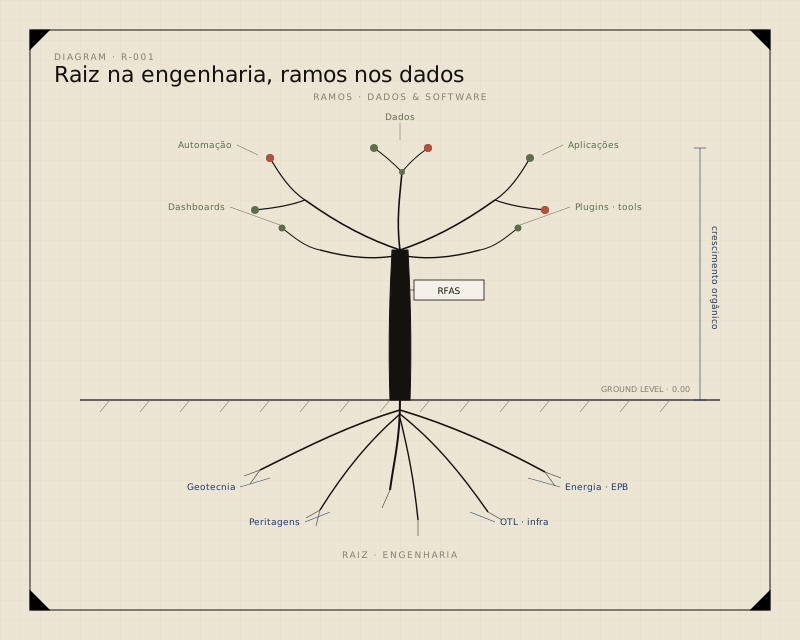
The basis is always the engineering problem. Technology comes in when it helps solve it better — a clearer spreadsheet, a small script, a tool that does one specific thing very well.
When the problem is big, RFAS recommends existing solutions. When it's specific, it builds. And if the best option is not to proceed, that's the recommendation.
As is now common knowledge, artificial-intelligence tools help and improve certain projects. RFAS uses them too — whenever it considers them convenient and necessary.
AI tools speed up concrete tasks — exploring code, reviewing documents, iterating on solutions. RFAS uses them like any other tool: when they make the result better or faster, with human review at the end.
When the work involves sensitive data, RFAS uses exclusively local AI models, running on its own machines. The data never passes through cloud services, is never exposed to the outside and is never used to train third-party models.
Describe the problem and the context. The reply indicates whether there's something concrete to do and the simplest scope to start with.